
BIS Certification for Cement in India – Complete IS Number Guide (All 16+ Types)
Every variety of cement manufactured or sold in India requires compulsory ISI Mark under BIS certification. This guide covers all cement types, their IS numbers, mandatory requirements, and what it takes to get certified.
Mandatory Requirement: Under the Cement (Quality Control) Order, 2003 (as amended), it is illegal to manufacture, store, sell, or import any cement in India without a valid BIS/ISI Mark license. This applies to all types of cement covered under BIS Indian Standards.
What is BIS Certification for Cement?
BIS (Bureau of Indian Standards) is India’s national standards body under the Ministry of Consumer Affairs. For cement, BIS operates a Product Certification / ISI Mark Scheme (Scheme I) that verifies cement meets specified Indian Standards (IS) for quality and safety.
Why is it called the “ISI Mark”? ISI stands for Indian Standards Institution – the predecessor to BIS. Today it is officially the BIS Standard Mark, but the common name “ISI Mark” continues to be used in trade and law.
The Cement (Quality Control) Order, 2003 (amended 2017, 2021) makes it mandatory for all cement varieties – whether manufactured in India or imported — to carry a valid BIS license before they can be sold in the Indian market. The Ministry of Commerce & Industry and DPIIT enforce these orders, with heavy penalties for non-compliance including seizure of goods and criminal prosecution.
All 16 Cement Types & Their IS Numbers
Below is a detailed breakdown of every cement variety covered under BIS compulsory certification. Each type is linked to its Indian Standard (IS) number — these IS numbers are what you need when filing your BIS application, writing blog cross-links, or specifying cement in construction projects.
01. Ordinary Portland Cement (OPC)
The backbone of Indian construction. OPC is made by grinding Portland cement clinker with a small quantity of gypsum. It is available in three strength grades — 33, 43, and 53 (and specialty grades 43S and 53S) — determined by the 28-day compressive strength in MPa. IS 269:2015 covers all grades under a single specification.
Primary Uses:
- Residential and commercial building construction
- Bridges, flyovers, highways, and infrastructure
- Concrete products (blocks, pipes, tiles)
- Wherever fast strength gain is required
IS Number: IS 269 : 2015 | Previous: IS 269 : 1989
02. Portland Pozzolana Cement – Fly Ash Based (PPC) (IS 1489 (Part 1) : 2015)
Eco-FriendlyFly Ash 15–35%Popular in IndiPPC (Fly Ash Based) blends clinker or OPC with 15–35% fly ash — a byproduct of thermal power plants. It produces lower heat of hydration, makes concrete more durable against chemical attack, and reduces CO₂ emissions. It is the second-most used cement in India after OPC.
Primary Uses:
- General building construction (most residential use)
- Marine and hydraulic structures
- Mass concrete where low heat is needed
- Sewage systems and water-retaining structures
IS Number: IS 1489 (Part 1) : 2015
03. Portland Pozzolana Cement – Calcined Clay Based (PPC) (IS 1489 (Part 2) : 2015)
Similar to Part 1 but uses calcined clay (processed at high temperature) instead of fly ash, either alone or combined with fly ash. The calcined clay content ranges from 10–25%. It offers comparable durability benefits to fly ash-based PPC and is especially useful in regions where fly ash is unavailable.
Primary Uses:
- General and residential construction
- Marine, coastal, and highway construction
- Regions without access to thermal fly ash
IS Number: IS 1489 (Part 2) : 2015
04. Portland Slag Cement (PSC) (IS 455 : 2015)
PSC is made by blending Portland cement clinker with 25–70% granulated blast furnace slag (a byproduct of steel manufacturing). It offers excellent resistance to chloride and sulphate attack due to the slag’s dense microstructure. PSC also generates less heat during hydration, reducing the risk of thermal cracking.
Primary Uses:
- Marine and coastal construction (jetties, ports)
- Sewage treatment plants and underground works
- Tunnels, foundations in aggressive soils
- Mass concrete structures (dams, retaining walls)
IS Number: IS 455 : 2015 | Previous: IS 455 : 1989
04. White Portland Cement (IS 8042 : 2015)
White cement is manufactured from raw materials with very low iron and manganese oxide content, giving it a characteristic white colour with a minimum whiteness index of 70%. It achieves comparable strength to grey OPC but at a significantly higher cost. Used primarily for aesthetic and architectural applications.
Primary Uses:
- Decorative plasters and renders
- Tile grout and terrazzo flooring
- White and coloured architectural concrete
- Swimming pool finishes, sculptures
IS Number: IS 8042 : 2015 | Previous: IS 8042 : 1989
06. Composite Cement (IS 16415 : 2015)
Composite cement is a blended cement that combines Portland cement clinker with both granulated blast furnace slag AND fly ash simultaneously. This dual supplementary approach further lowers the clinker-to-cement ratio, reducing CO₂ emissions compared to either PSC or PPC alone. It also provides better resistance to chlorides and sulphates.
Primary Uses:
- General construction where sustainability matters
- Industrial floors and infrastructure projects
- Structures in aggressive chemical environments
- Green building projects (GRIHA, LEED certified)
IS Number: IS 16415 : 2015
07. Masonry Cement (IS 3466 : 1988)
Masonry cement is specially formulated for use in mortars for bricklaying, stonework, blockwork, rendering, and plastering. It is NOT suitable for structural concrete applications. It offers improved workability and water retention compared to OPC mortars, making it easier to lay bricks without excessive mortar slump.
Primary Uses:
- Brick, stone, and block masonry
- Wall rendering and plastering
- Pointing mortars
- Not for: RCC, foundations, or load-bearing concrete
IS Number: IS 3466 : 1988
08. Rapid Hardening Portland Cement (RHPC) (IS 8041 : 1990)
RHPC is ground finer than OPC and has a higher tricalcium silicate (C₃S) content, allowing it to reach its 3-day strength equivalent in just 1 day. This makes it ideal for time-critical construction where early loading or formwork removal is essential.
Primary Uses:
- Prefabricated concrete products (pre-tensioned work)
- Emergency road and runway repairs
- Cold weather concreting
- Early demoulding of formwork
IS Number: IS 8041 : 1990
09. Hydrophobic Portland Cement (IS 8043 : 1991)
Hydrophobic cement is manufactured by grinding Portland cement clinker with water-repelling agents (like oleic acid, stearic acid, or pentachlorophenol). These agents coat each cement particle, preventing premature hydration during storage in damp or coastal conditions. During mixing, the agitation breaks this coating and normal hydration begins.
Primary Uses:
- Construction in humid, coastal, and tropical regions
- Structures exposed to water seepage
- Damp basements and substructures
- Long-term storage in humid warehouses
IS Number: IS 8043 : 1991
10. Oil Well Cement (IS 8229 : 1986)
Oil Well Cement is engineered for cementing steel casing into oil and gas boreholes under extreme conditions — very high temperatures (up to 260°C) and very high pressures. IS 8229 defines Classes A through J, each suited to different depth and temperature conditions. The cement must resist premature setting while being pumped deep into the well, then set quickly once placed.
Primary Uses:
- Oil and natural gas well casing (ONGC, Oil India operations)
- Cementing boreholes in geothermal energy projects
- Plugging and abandoning wells
IS Number: IS 8229 : 1986
11. Sulphate Resisting Portland Cement (SRPC) (IS 12330 : 1988)
SRPC is made by restricting the tricalcium aluminate (C₃A) content to a maximum of 3.5%, which is the compound most vulnerable to sulphate attack. This makes SRPC highly resistant to sulphate-bearing soils, groundwater, and seawater. It is mandated by design codes wherever sulphate levels in soil or water exceed permissible limits.
Primary Uses:
- Foundations in sulphate-bearing soils (coastal belts, Rajasthan, Gujarat)
- Sewage treatment and wastewater structures
- Structures in contact with seawater
- Industrial foundations with chemical exposure
IS Number: IS 12330 : 1988
12. Low Heat Portland Cement (LHPC) ( IS 12600 : 1989)
LHPC is designed with a lower C₃S and C₃A content to produce significantly less heat during hydration. This prevents thermal cracking in large concrete pours where the mass retains heat. It gains strength more slowly than OPC but achieves equivalent final strength. Used in India’s major dam projects.
Primary Uses:
- Large dams and barrages (mass concrete)
- Thick bridge piers and raft foundations
- Water-retaining structures and reservoirs
- Nuclear plant foundations and large industrial bases
IS Number: IS 12600 : 1989
13. High Alumina Cement for Structural Use (IS 6452 : 1989)
Also called calcium aluminate cement (CAC), HAC for structural use contains a minimum of 32% alumina (Al₂O₃). It achieves very high early strength (within 24 hours) and excellent resistance to chemical and thermal attack. However, structural use is restricted — it is only allowed for cold regions where ambient temperature does not exceed 18°C, due to conversion risks at higher temperatures.
Primary Uses:
- Structural use in cold climate regions only (temp ≤ 18°C)
- Refractory castables and furnace linings (see also IS 15895)
- Sewers exposed to acidic effluents
- Mining applications requiring rapid strength
IS Number: IS 6452 : 1989
14. Supersulphated Cement (SSC) (IS 6909 : 1990)
Supersulphated cement contains a minimum 70% granulated blast furnace slag, activated by calcium sulphate (gypsum or anhydrite) and a small amount of Portland cement clinker or lime. It offers exceptional resistance to sulphates, acids, and sea water — even more so than SRPC — and produces very low heat of hydration.
Primary Uses:
- Structures in highly aggressive sulphate environments
- Mine drainage structures and sewers
- Foundations in acidic soils
- Marine works in highly saline conditions
IS Number: IS 6909 : 1990
15. Microfine Ordinary Portland Cement (IS 16993 : 2018)
Microfine OPC is ordinary Portland cement ground to a very fine particle size using ultra-fine classification equipment. The extremely small particles can penetrate micro-cracks and fine fissures in rock and soil. This specification (IS 16993:2018) is relatively new and standardizes what was previously only available as specialty import products.
Primary Uses:
- Rock grouting for tunnels and dam foundations
- Soil stabilization and consolidation
- Crack sealing in heritage structures
- Underground leak prevention in metro and hydro projects
IS Number: IS 16993 : 2018 (IS 15895 : 2018)
16. High Alumina Refractory Cement
Unlike IS 6452 (which covers structural use at limited temperatures), IS 15895 covers high alumina refractory cement specifically designed for refractory castables and linings used at very high temperatures in industrial furnaces, kilns, and boilers. The alumina content and performance criteria differ significantly from the structural grade.
Primary Uses:
- Refractory castables for furnace and kiln linings
- Boiler and incinerator refractory applications
- Steel plant and cement plant high-temperature zones
- Petrochemical high-temperature linings
IS Number: IS 15895 : 2018
17. Portland Limestone Calcined Clay Cement (LC3) (IS 18189 : 2023)
LC3 (Limestone Calcined Clay Cement) is the newest cement standard under BIS, published in 2023. It blends Portland cement clinker (or OPC) with calcined clay and limestone — a combination that can reduce CO₂ emissions by 30–40% compared to OPC. LC3 is part of India’s push toward sustainable construction materials and aligns with global decarbonisation goals for the cement industry.
Primary Uses:
- General construction with sustainability requirements
- Green building projects (Net Zero targets)
- Government infrastructure where low-carbon materials are specified
- Smart Cities and AMRUT projects
IS Number: IS 18189 : 2023
Quick Reference: All Cement Types & IS Numbers
Use this table to quickly look up IS numbers for cross-linking or project specifications. All covered under the BIS Scheme I compulsory certification.
| # | Cement Type | IS Number | Category | Anchor ID (For Blog Linking) |
|---|---|---|---|---|
| 1 | Ordinary Portland Cement (OPC) | IS 269 : 2015 | General | #opc |
| 2 | Portland Pozzolana Cement — Fly Ash Based | IS 1489 (Part 1) : 2015 | Blended | #ppc-fly-ash |
| 3 | Portland Pozzolana Cement — Calcined Clay Based | IS 1489 (Part 2) : 2015 | Blended | #ppc-calcined-clay |
| 4 | Portland Slag Cement (PSC) | IS 455 : 2015 | Blended | #psc |
| 5 | White Portland Cement | IS 8042 : 2015 | Specialty | #white-cement |
| 6 | Composite Cement | IS 16415 : 2015 | Blended | #composite-cement |
| 7 | Masonry Cement | IS 3466 : 1988 | Mortar | #masonry-cement |
| 8 | Rapid Hardening Portland Cement (RHPC) | IS 8041 : 1990 | Specialty | #rhpc |
| 9 | Hydrophobic Portland Cement | IS 8043 : 1991 | Specialty | #hydrophobic-cement |
| 10 | Oil Well Cement | IS 8229 : 1986 | Industrial | #oil-well-cement |
| 11 | Sulphate Resisting Portland Cement (SRPC) | IS 12330 : 1988 | Specialty | #src |
| 12 | Low Heat Portland Cement (LHPC) | IS 12600 : 1989 | Specialty | #low-heat-cement |
| 13 | High Alumina Cement for Structural Use | IS 6452 : 1989 | Specialty | #high-alumina-structural |
| 14 | Supersulphated Cement (SSC) | IS 6909 : 1990 | Specialty | #supersulphated-cement |
| 15 | Microfine Ordinary Portland Cement | IS 16993 : 2018 | Specialty | #microfine-cement |
| 16 | High Alumina Refractory Cement | IS 15895 : 2018 | Refractory | #high-alumina-refractory |
| 17 | Portland Limestone Calcined Clay Cement (LC3) | IS 18189 : 2023 | Low Carbon | #lc3-cement |
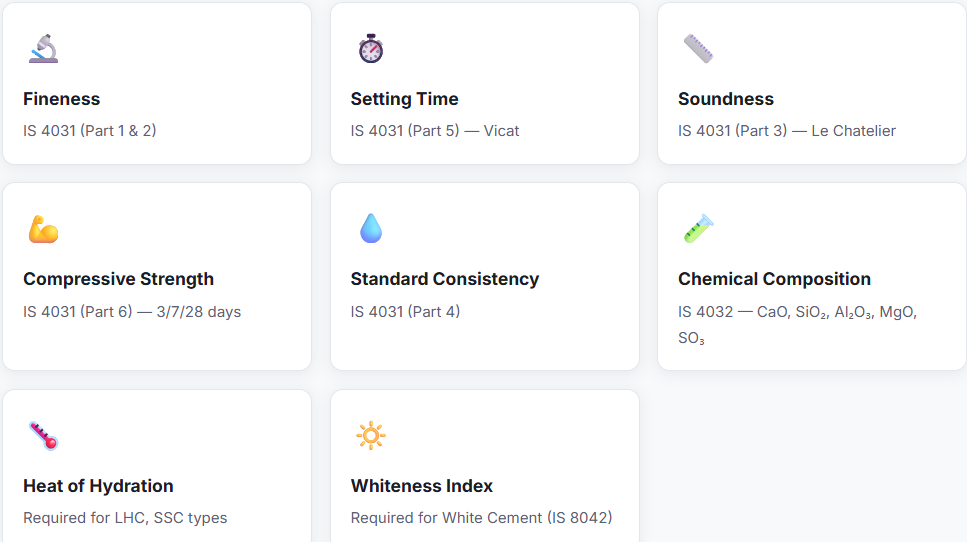
Key Tests Under BIS Cement Certification
BIS requires cement to be tested at a NABL-accredited or BIS-approved laboratory. The following physical and chemical tests are mandatory for most cement types.
Documents Required for BIS Cement Certification
Compile these documents before applying. Missing documents are the most common reason for delayed BIS approvals.
| # | Document | Domestic Manufacturer | Importer/Foreign Mfr. |
|---|---|---|---|
| 1 | Certificate of Incorporation / Registration | ✔ | ✔ |
| 2 | PAN Card | ✔ | ✔ (Indian AIR) |
| 3 | GST Registration Certificate | ✔ | ✔ |
| 4 | MSME Registration (if applicable) | ✔ | — |
| 5 | IEC (Import Export Code) | — | ✔ |
| 6 | Factory Layout Plan & Process Flow Diagram | ✔ | ✔ |
| 7 | Plant & Machinery Details with Capacities | ✔ | ✔ |
| 8 | Raw Material Sources & Quality Data | ✔ | ✔ |
| 9 | NABL Lab Test Reports (against IS specification) | ✔ | ✔ |
| 10 | Quality Control Manual | ✔ | ✔ |
| 11 | QC Equipment List with Calibration Records | ✔ | ✔ |
| 12 | Packaging Sample / Mockup with ISI Mark Space | ✔ | ✔ |
| 13 | Trademark Documents (if any) | ✔ | ✔ |
| 14 | Authorised Indian Representative (AIR) Agreement | — | ✔ (Mandatory) |
| 15 | Country of Origin Certificate | — | ✔ |
BIS Cement Certification: Step-by-Step Application Process
- Identify Your Cement Type & Applicable IS Standard
Use the reference table above to map your cement product to its IS number. Each IS standard has specific requirements for composition, strength, and testing. Your entire application, lab tests, and factory setup must align with this IS number.
2. Set Up In-House Quality Control Laboratory
BIS requires the manufacturing plant to have an in-house QC lab equipped with the testing instruments specified under the IS standard (Vicat apparatus, Le Chatelier mould, compression testing machine, fineness apparatus, etc.). All equipment must be calibrated and records maintained.
3. Get Samples Tested at NABL-Accredited Lab
Before applying, test samples at a NABL-accredited or BIS-empanelled laboratory. Test reports must confirm compliance with all parameters of the relevant IS specification. These reports form the backbone of your BIS application.
4. Prepare Documents & Apply on BIS Portal
Create a login on manak.gov.in (BIS official portal). Fill the application for Scheme I certification, attach all documents (see table above), and pay the application fee. The fee varies based on company size and certification scope.
5. BIS Factory Inspection
BIS will assign a Technical Officer who visits your manufacturing facility. They inspect the plant, raw materials, process, in-house QC lab, and documentation. They also collect samples for independent testing at a BIS-approved lab. This is a critical stage — gaps in QC documentation or equipment calibration can delay approval.
6. Grant of License & Use of ISI Mark
On successful inspection and sample test results, BIS grants a License Number (CM/L-XXXXXXX). You can now use the ISI Mark on your cement packaging. The mark must include the license number, IS number, and BIS logo — all mandated by law to be printed on every cement bag.
7. Ongoing Surveillance & Annual Renewal
BIS conducts random market surveillance — picking bags from retailers and testing them. The license must be renewed periodically (typically every 1–3 years, depending on compliance history). BIS can suspend or cancel the license if samples fail tests or QC records are found deficient.
For Importers & Foreign Manufacturers
No cement can be imported into India without a valid BIS license. Customs authorities will reject any consignment without a valid CM/L license number on the packaging, even if the cement meets quality standards in its country of origin.
Foreign manufacturers must follow the BIS Foreign Manufacturers Certification Scheme (FMCS). Key differences from domestic certification:
| Requirement | Details |
|---|---|
| Authorised Indian Representative (AIR) | Mandatory — an Indian entity responsible for compliance, communication with BIS, and market surveillance |
| Factory Inspection | BIS officers travel to the foreign manufacturing plant — applicant bears travel costs (flights, stay, visa for BIS officers) |
| Validity | Typically 1–2 years; shorter than domestic licenses |
| Port Inspection | Customs may check each consignment for IS compliance at port of entry |
| IEC Code | Importer must have a valid Import Export Code from DGFT |